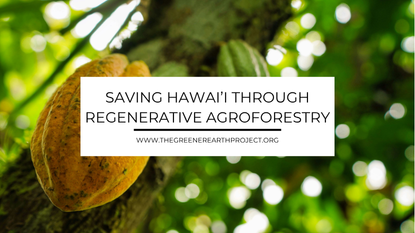
Cocoa farmers in Hawai’i are fighting back against centuries of environmental abuse due to sugar plantations. They are practising regenerative agroforestry, which in this case means growing agricultural produce in a forest environment. The regenerative aspect is that their farming methods are putting more back into the land than they take out. Farmers’ efforts have improved annual yields, abated erosion, and improved habitats.
Hawaiian farming history
Sugar can has been grown in Polynesia, including Hawai’i, for centuries. However, production surged in Hawai’i during the American Civil War, when Louisiana stopped transporting sugar. Plantations in Hawai’i spread quickly, and covered thousands of acres by 1941. Despite tariffs on sugar being lifted in the 1870s, the USA annexed Hawai’i in 1898.
The plantations’ need for water negatively impacted the islands, with streams being diverted to irrigate fields. This had a negative impact on ecosystems and native Hawaiians, who felt that plantations were taking too much and not leaving enough for the land or the people.
Hawaiian farming now
Researchers have found that nutrient stocks and microbial biomass and respiration are greater in agroforestry than monocultural systems. Soil that has been built up over millions of years is difficult to replace, but it is so important for plants. Farmers are fighting the repercussions of plantation agriculture that has damaged the topsoil.
Some farmers have created lowland forest that would have existed in Hawai’i if the land had not been deforested for sugar plantations. Native wildlife has returned to these forests, and farmers have seen symbiotic benefits in the soil as a result of a diverse forest.
However, climate change is making things more difficult for farmers. Hawai’i is experiencing intense periods of droughts and rain, which dries out the soil and washes it away, respectively. The soil that is washed away ends up in the ocean, such as Kaiaka Bay by Oahu. The amount of sediments and contaminants, which could include chemical pollutants, has increased in Kaiaka Bay.
Farmers are protecting their land by planting his cocoa trees under black matting and mulch, along with native saplings. The matting and mulch will protect the topsoil, while the native trees will grow faster and will protect the cocoa trees. They will provide a habitat and improving the soil and ecosystem.
Planting local trees means that they will reduce the soil erosion from wind and water. They will improve drainage, preventing soil from being compacted and reduces farm-related pollutants from draining into watercourses by up to 80%. They can become a semi-permeable barrier that can slow down wind, preventing topsoil erosion and reducing moisture loss during droughts.