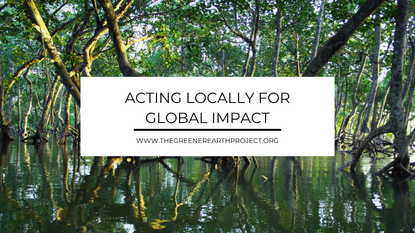
The International Day for Biological Diversity (IDB) 2026 was celebrated on 22nd May. It is celebrated every year with a different theme, and this year it was ‘Acting locally for global impact’.
This new theme aims to halt and reverse biodiversity loss, which hinges on local action and government-led efforts. While the latter is hard to implement on an individual level, your support helps with local action.
With your help, and in partnership with other organisations, we have been able to halt and reverse biodiversity loss, which has impacted the local community and the world.
What your support does
The Greener Earth Project supported the Community-Based Environmental Conservations (COBEC) to implement hydrological restoration activity at Mida Creek, Kenya. The aim was to improve tidal water flow and to enhance mangrove ecosystem recovery. Re-establishing the natural hydrology of degraded mangroves is essential for sustaining biodiversity and community livelihoods.
The restoration started with hydrological training for community members, emphasising the principles for water flow management, tidal channel rehabilitation, and site selection. This training is instrumental to equip the community with the technical knowledge to restore and maintain natural tidal flow. Understanding both helps to prevent water logging, ensures proper seedling establishment, and supports long-term mangrove survival. It builds the community’s capacity to manage future restoration, which will enhance local resilience to coastal erosion and rising sea levels.
With help from the local community, 680 Avicennia marina trees were planted in strategically selected degraded zones in the creek.
Many of the local community involved in the project were women. Local women played a key role in the process, digging trenches and planting the trees. Including women promoted gender inclusion and strengthened local stewardship and ownership of the process. This project has economically empowered local women with paid work, and has strengthen their role in community-led conservation.
The trees that were planted thanks to your donations have shown ecological and socio-economic benefits. Restored water flow has improved soil aeration and salinity balance, which has created favourable conditions for natural regeneration. We expect the new trees to stabilise sediments, enhancing nursery habitats for fish and crab, and sequester carbon, contributing to climate change mitigation.
Why this work is important
Mangroves are essential for coastal communities, marine biodiversity, and the global climate. They protect the coast from erosion and storm surges; provide habitats for fish and crustaceans, supporting local fisheries; sequester carbon to mitigate climate change; and provides opportunities for eco-tourism and sustainable resource.
Mida Creek is UNESCO Biosphere Reserve and is a critical habitat for migratory birds along the African-Eurasian flyway. It is a globally significant ecosystem that needs long-term protection and sustainable management.
Your donations have supported our work in Kenya with COBEC, who are working with the Kenya Forest Service (KFS) to support patrols to stop illegal logging and comply with forest regulations. Illegal logging to build houses and to make charcoal is still a problem as a result of poverty due to limited livelihood alternatives and a lack of awareness of the ecological and economical values of the mangroves. However, rising sea levels and increasing sedimentation are also factors.